

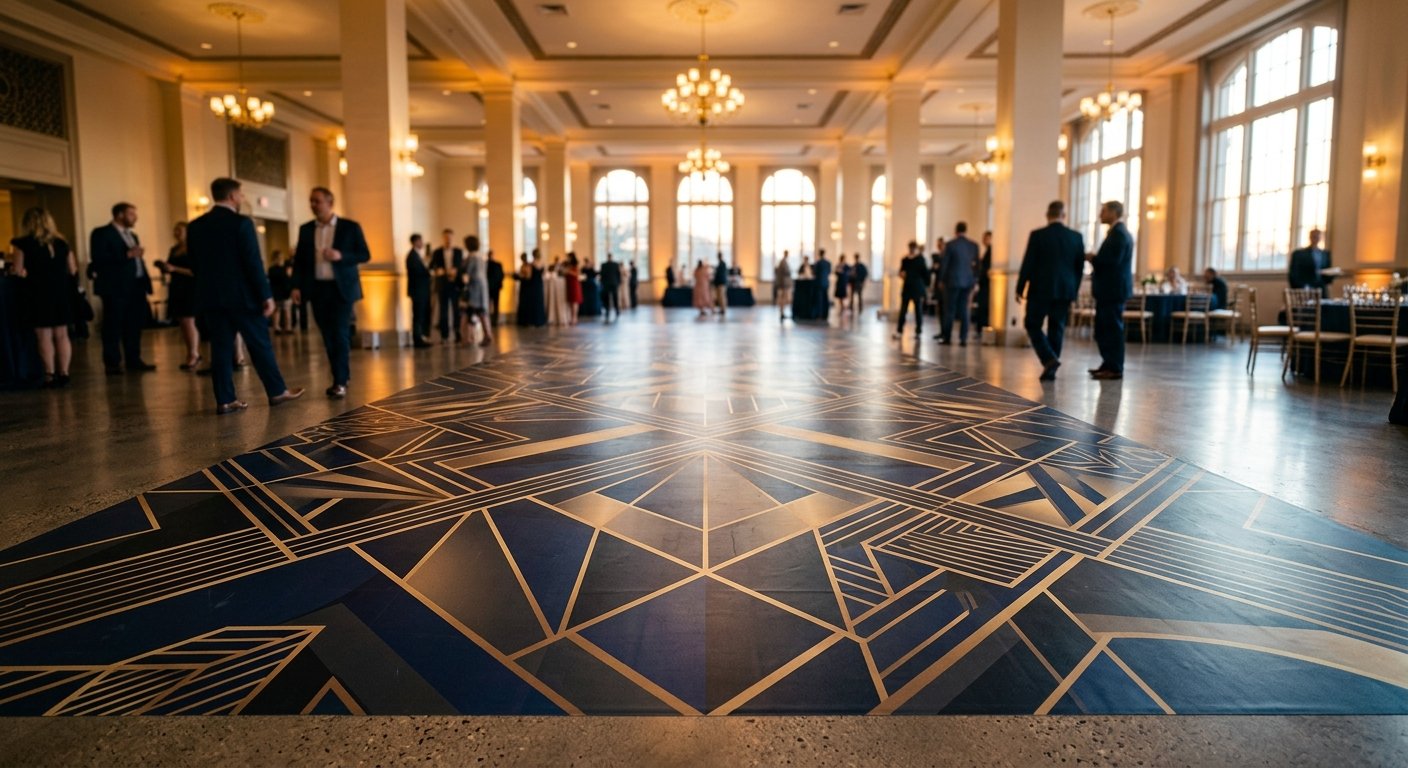
Floor wraps for events are large-format vinyl graphics applied directly to hard flooring surfaces—concrete, tile, wood, or carpet-protected substrates—to create branded, directional, or decorative environments. They’re a proven solution for trade shows, product launches, corporate gatherings, and retail activations where visual impact at the ground level reinforces a brand message and guides foot traffic.
- Event floor graphics use pressure-sensitive vinyl engineered for temporary adhesion and safe removal without surface damage.
- Material selection matters enormously—skid resistance, slip ratings, and substrate compatibility are non-negotiable safety concerns.
- South Florida’s high humidity affects adhesion; professional installation by a 3M Certified installer dramatically reduces failure risk.
- Proper surface prep, correct laminate selection, and post-event removal technique determine whether your flooring escapes unharmed.
- Temporary floor wraps can be paired with wall and ceiling graphics for fully immersive event environments.
Why Floor Graphics Belong in Your Event Strategy
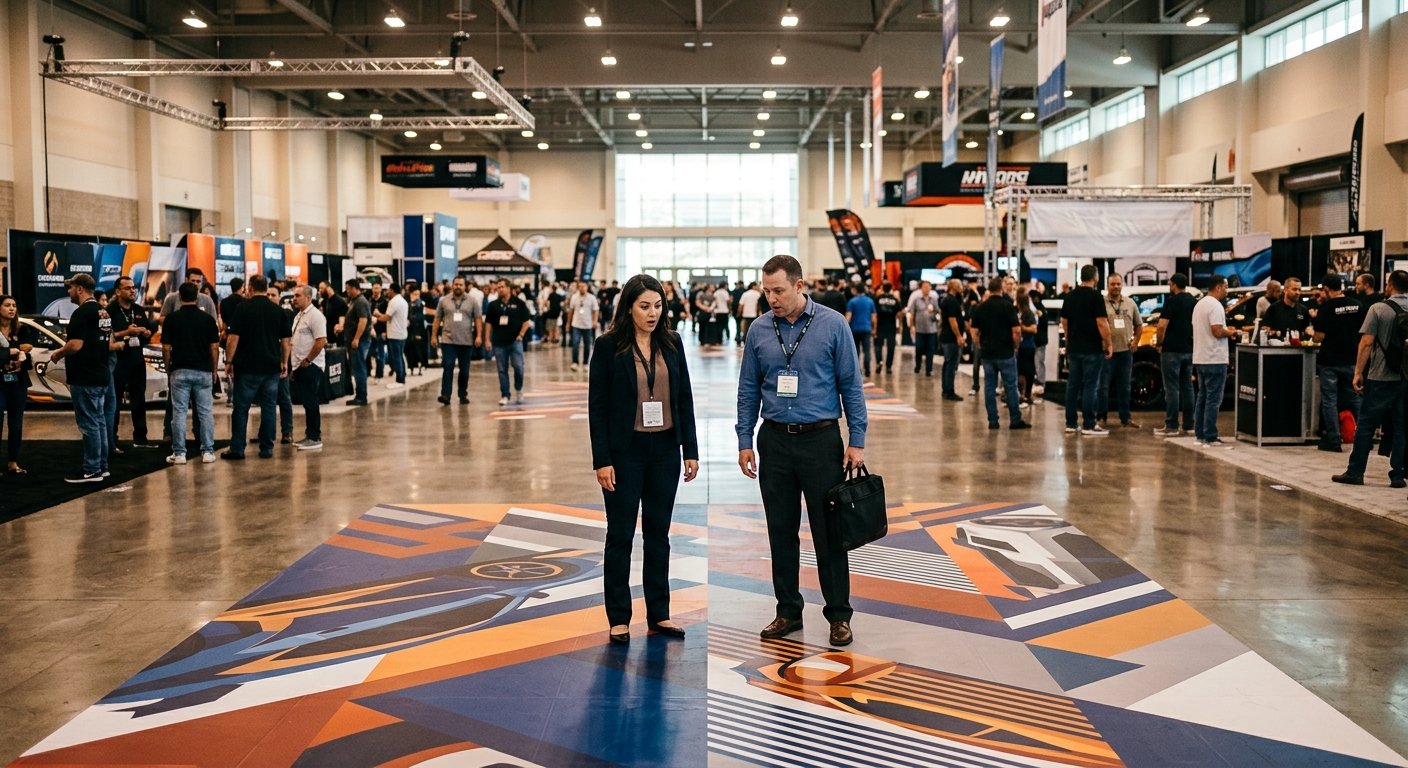
Event marketing has always competed for attention at eye level—banners, backdrops, digital screens. But the floor is one of the most underutilized brand canvases in any venue. Attendees look down constantly, especially in crowded rooms. A well-executed floor graphic creates a moment of surprise, reinforces a brand message at a subconscious level, and can guide traffic flow through complex event layouts far more elegantly than stanchions or signage poles.
For corporate events, product launches, and trade show booths, floor wraps deliver something rare: branded square footage that competitors rarely occupy. The visual consistency between a floor graphic, a branded wall wrap, and a custom backdrop signals professionalism and intentionality to every attendee who walks through the door.
The floor is one of the most underutilized brand canvases in any venue—and one of the most memorable when executed correctly.
Materials: What Separates Professional-Grade from Everything Else
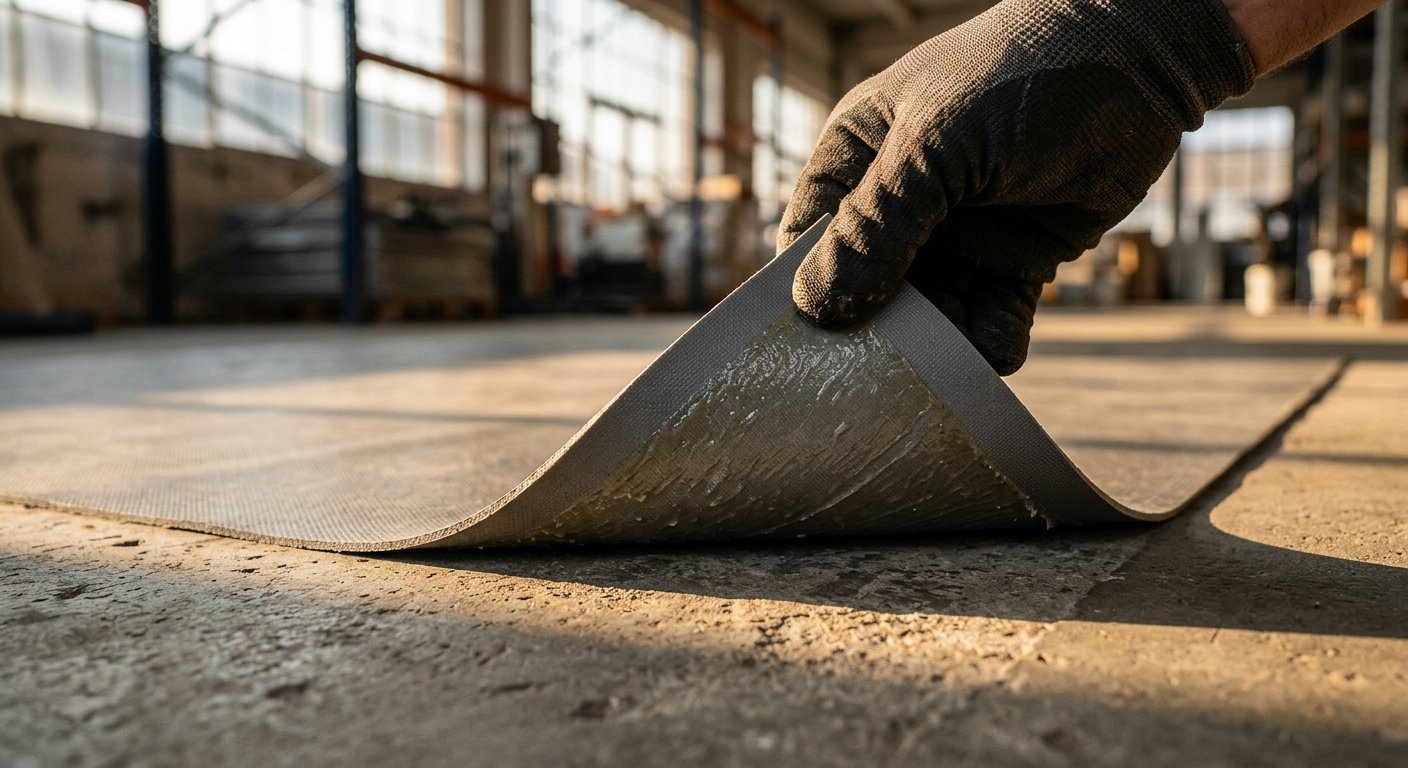
Not all floor vinyl is created equal, and in an event context, the wrong material choice creates two serious problems: safety liability and surface damage. Professional-grade event floor graphics use pressure-sensitive vinyl films specifically engineered for floor applications—these differ fundamentally from wall or vehicle wrap films.
Key Material Properties to Understand
The National Floor Safety Institute provides guidance on slip-resistance standards for floor coverings, and any graphic applied to a walking surface must meet applicable requirements. Professional floor graphic films are paired with anti-skid laminates that bring the surface coefficient of friction to compliant levels. This is not optional—it is a liability issue for every event organizer.
- Anti-skid laminate: A textured overlaminate that provides traction underfoot while protecting the printed graphic.
- Conformable film: Allows the wrap to lay flat over grout lines, minor surface imperfections, and transitions.
- Air-release channels: Microscopic channels in the adhesive layer that allow trapped air to escape during installation, preventing bubbles.
- Removable adhesive: Engineered to release cleanly within a defined window—typically the length of an event—without pulling up floor coatings or leaving residue.
At Florida Car Wrap, our work with 3M-certified materials means we’re selecting films from a manufacturer that documents performance data for floor applications, including adhesion values, removal windows, and surface compatibility. That documentation matters when a venue manager needs assurance that their floors won’t be damaged.
Using standard wall vinyl or vehicle wrap film on event floors is a genuine safety hazard. These materials lack anti-skid laminates and can become dangerously slippery underfoot, especially in South Florida’s humidity where condensation is a real factor. Always specify floor-rated film for any walking surface application.
Substrate Compatibility: Every Floor Is Different
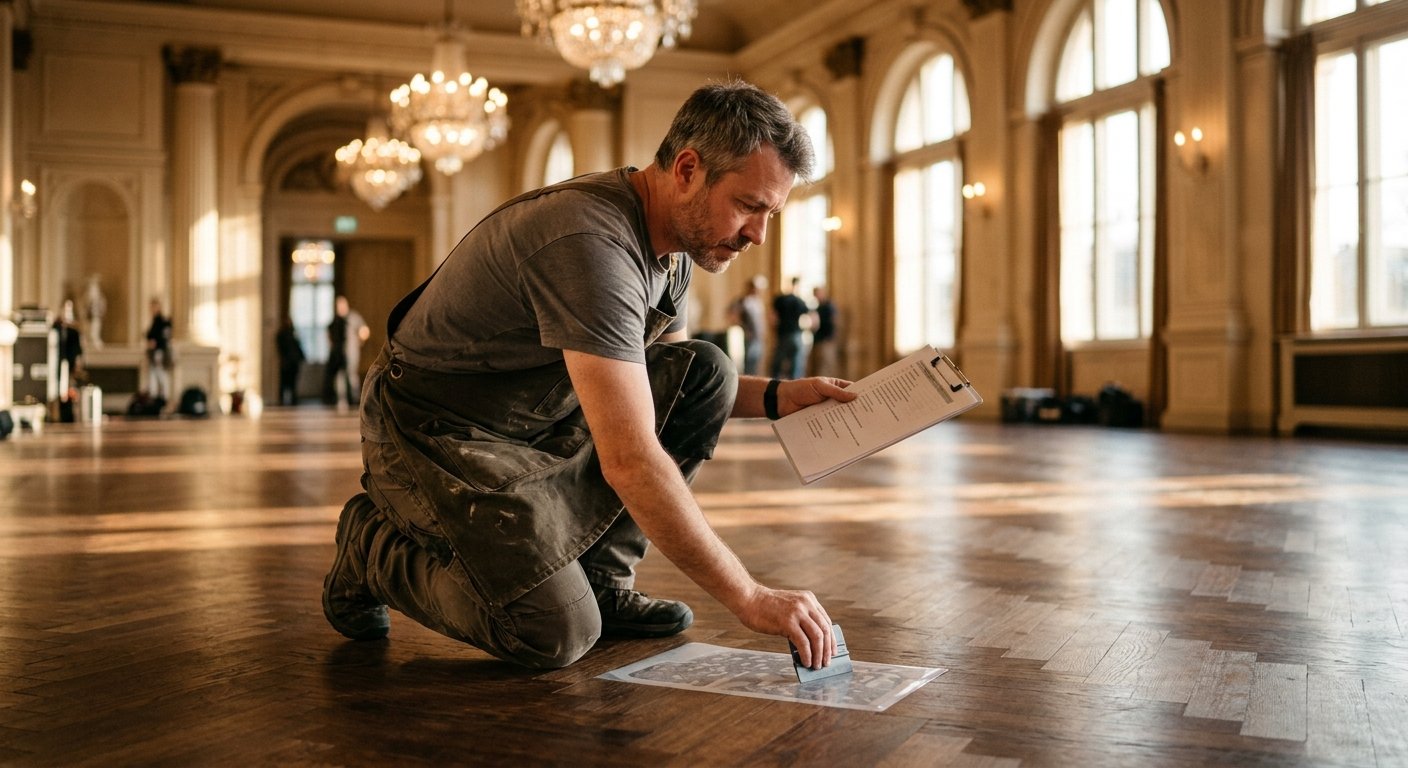
One of the most common planning mistakes is treating floor graphic installation as a one-size-fits-all process. The substrate—the actual floor surface—dictates material selection, surface preparation requirements, and removal technique. Getting this wrong risks both graphic failure during the event and damage to the venue’s flooring afterward.
| Substrate Type | Key Considerations | Professional Prep Required |
|---|---|---|
| Polished concrete | Excellent adhesion; very unforgiving of dust or moisture | Cleaning, degreasing, pH testing |
| Ceramic or porcelain tile | Grout lines require conformable film; adhesion varies | Grout line profiling, edge sealing |
| Hardwood (sealed) | Finish type determines adhesion compatibility | Finish identification, test patch |
| Carpet | Direct wrap not possible; rigid substrate overlay needed | Substrate board installation first |
| Vinyl composite tile (VCT) | Wax buildup is the primary adhesion enemy | Strip wax, clean thoroughly |
South Florida venues introduce a specific challenge: humidity. High ambient moisture levels can compromise adhesion if the floor surface hasn’t fully stabilized to indoor conditions. An experienced installer accounts for this by checking surface temperature and moisture content before application—steps that separate professional-grade work from rushed installations that fail mid-event.
The Installation Process: What to Expect
Understanding the installation sequence helps event planners build realistic timelines and coordinate with venue managers effectively. A professional floor graphic installation is a structured process, not simply “apply and walk away.”
Site Survey
The installer assesses the substrate type, surface condition, square footage, existing coatings, and venue restrictions. This determines material selection and prep requirements before any graphic is produced.
Surface Preparation
The floor is cleaned, degreased, and—depending on the substrate—stripped of wax or contaminants. Any moisture issues are identified and resolved. This step directly determines adhesion quality and removal ease.
Graphic Application
Panels are applied in sequence, with air squeegeed out systematically. Seams are aligned precisely, edges are sealed, and the anti-skid laminate is confirmed in place across all walking surfaces.
Inspection and Edge Sealing
All edges are pressed and sealed to prevent lifting from foot traffic or cleaning equipment during the event. This is a critical quality step that budget installations routinely skip.
Post-Event Removal
Within the material’s designed removal window, the graphic is lifted at low angles and the surface is cleaned of any residue. Proper technique here protects the venue and your relationship with it.
Designing for Maximum Impact
The most effective event floor graphics treat the floor as a designed environment, not a billboard lying flat. Perspective distortion—artwork adjusted so it reads correctly from standing eye height—creates dramatic visual effects. Directional graphics can guide attendees through a space intuitively. Brand patterns used subtly across a large floor area create ambient immersion rather than a hard sell.
For large event spaces, consider coordinating your floor graphic design with wall and ceiling elements. Florida Car Wrap’s architectural wrap services cover all three planes, allowing a single cohesive visual concept to transform an entire venue interior rather than just the ground level.
File preparation for floor graphics follows different rules than standard print. Because viewers are looking at the graphic from multiple angles and distances—and often walking across it—images need to be designed at true scale with attention to foot traffic paths. Areas where people will stand should carry the main design; high-traffic crossing zones should use patterns or secondary elements that hold up under wear.
Temporary vs. Semi-Permanent Floor Graphics
The term “temporary” in floor wraps refers to the adhesive system and the installation’s intended lifespan—not the graphic quality. Temporary event floor graphics use removable adhesive formulations designed for clean release, whereas semi-permanent architectural floor wraps use higher-tack systems intended to last through months of daily commercial foot traffic.
For event applications, removable is almost always correct. It protects the venue, satisfies most venue contracts, and allows reuse of the graphic panels if they’re removed carefully. For permanent brand installations in owned commercial spaces—a showroom, a lobby, a retail environment—semi-permanent systems offer superior durability. Our architectural graphics work covers both scenarios, with material selection driven by the specific use case.
Working with Your Venue
Most South Florida venues—convention centers, hotel ballrooms, private event spaces—have explicit policies about what can be applied to their floors. Getting written approval before any installation is non-negotiable. A professional installer can provide venues with material data sheets, adhesion test results, and documented removal procedures that satisfy property managers who’ve had bad experiences with amateur installations in the past.
This is where 3M Certified installation documentation carries real weight. It’s not just a quality credential—it’s evidence that the materials used have manufacturer-documented performance characteristics, including removal behavior. Venue managers respond to that documentation in ways they simply don’t to unverifiable claims from uncertified installers.
Frequently Asked Questions
Will floor wraps damage my venue’s flooring?
When professional-grade removable vinyl is installed correctly and removed within its designed window, damage to the underlying floor is highly unlikely. The risk increases significantly with non-floor-rated materials, improper removal technique, or leaving graphics down past the adhesive’s designed removal window. Always work with a certified professional and get material documentation in advance to satisfy your venue’s requirements.
How far in advance should event floor graphics be ordered?
For custom-printed floor graphics, plan for a minimum of two to three weeks for design finalization, print production, and scheduling of the installation. Large-scale events requiring multiple panels, complex designs, or coordination with wall graphics benefit from four to six weeks of lead time. Rushing production or installation compromises both print quality and adhesion.
Are floor wraps safe for event attendees?
Yes, when the correct materials are specified. Professional event floor graphics use anti-skid laminates that meet applicable slip-resistance standards. The critical detail is that not all vinyl films are appropriate for floor use—materials without anti-skid overlaminate create genuine slip hazards. Always confirm that your installer is specifying floor-rated film, not repurposing wall or vehicle wrap vinyl.
Can floor graphics be reused at multiple events?
Reuse depends on how carefully the graphic is removed and rolled, and whether the adhesive system supports reapplication. Some removable films can be repositioned once or twice if handled with care; others are single-use. Discuss reuse requirements with your installer before production so the appropriate material and adhesive system are selected from the start.
How do floor wraps compare to carpet overlays or printed carpet for events?
Printed vinyl floor graphics offer sharper image reproduction, easier installation and removal, and lower per-event cost for custom designs. Carpet overlays provide a different tactile experience and may be preferred for formal events. For brand-critical applications where color accuracy and graphic detail matter—product launches, trade shows, brand activations—vinyl floor graphics consistently outperform carpet in visual precision.
Making Floor Graphics Part of a Larger Brand Environment
The most visually powerful event installations treat every surface as part of one unified design system. Floor graphics work in concert with custom vehicle wraps on brand vehicles parked at the entrance, wall graphics inside the venue, and even ceiling treatments for fully immersive environments. For brands that take their visual presentation seriously, this level of coordination is exactly what separates a memorable event from a forgettable one.
Florida Car Wrap brings this integrated approach to South Florida events, drawing on the same commercial branding expertise we apply to fleet vehicles and the same material standards we use for custom automotive work. The craftsmanship standard doesn’t change because the surface is horizontal.
Ready to plan your event floor graphics?
Contact Florida Car Wrap to discuss your event timeline, venue requirements, and design vision—our team will recommend the right materials and approach for your specific application.

About Florida Car Wrap
Florida Car Wrap delivers premium vehicle wrap services specializing in commercial fleet branding, luxury car customization, and marine-grade wraps throughout South Florida. Led by award-winning wrap professional Steve Hargittai, the company combines 3M-certified materials with competition-proven craftsmanship to serve discerning business owners and automotive enthusiasts who value longevity and quality over price. Their expertise extends beyond vehicles to architectural graphics, wall wraps, and floor wraps, all executed with attention to South Florida's unique climate demands including UV exposure and salt air considerations. Visit floridacarwrap.com →
