
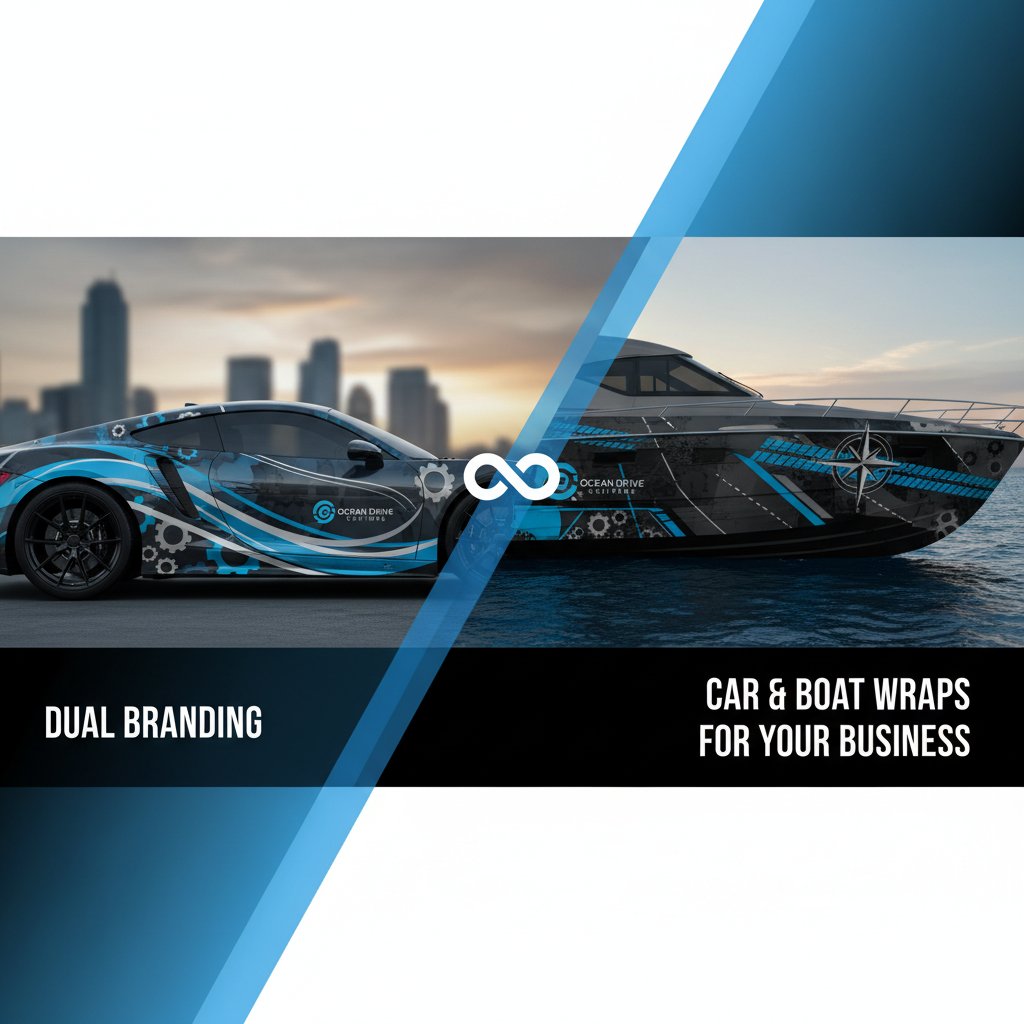
When your business operates both on land and water, your branding should maintain consistency across every touchpoint. A logistics company that delivers by van and operates a fleet of service boats faces the same challenge as a luxury real estate firm shuttling clients in branded vehicles and yachts: how to create cohesive visual identity across fundamentally different surfaces. The solution lies in strategic dual branding through professional car and boat wraps that account for the distinct demands of automotive and marine environments.
Why Dual Branding Matters for Multi-Platform Businesses
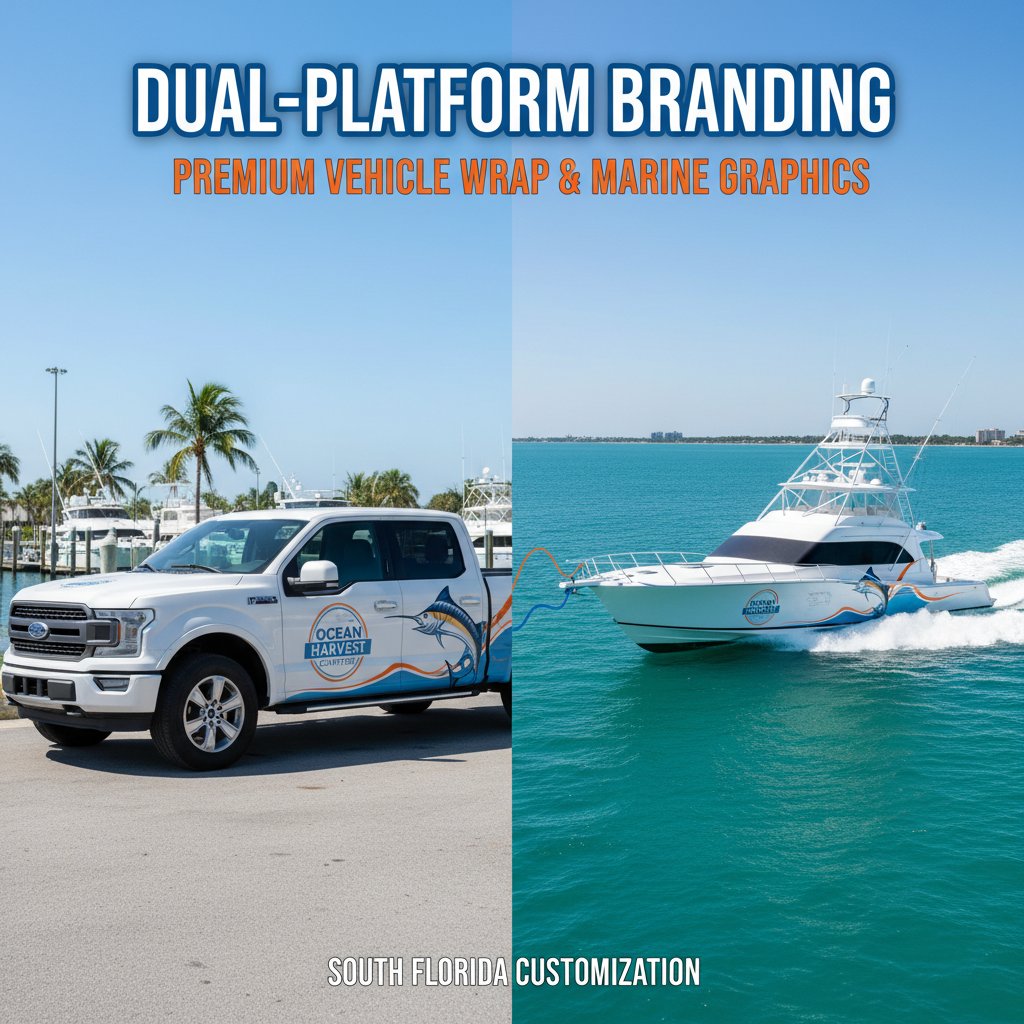
Brand recognition builds through repetition and consistency. When your company vehicles and watercraft display unified graphics, you’re reinforcing brand memory with every impression. A charter fishing company whose truck appears at the marina and whose boat navigates the Intracoastal creates twice the visibility—but only if both displays present cohesive branding that customers instantly recognize.
The challenge extends beyond simply slapping the same logo on different surfaces. Automotive and marine environments demand different materials, installation techniques, and design considerations. A car wrap that performs beautifully on a delivery van won’t necessarily withstand constant saltwater exposure, and marine-grade materials require specialized knowledge to install correctly on vehicle substrates.
Material Differences Between Car and Boat Wraps
Professional vehicle marine wrap companies understand that material selection drives longevity and appearance retention. While 3M’s automotive vinyl films dominate the car wrapping industry, marine applications require materials engineered specifically for watercraft environments.
Automotive Wrap Materials
Standard automotive wraps utilize cast vinyl films that conform to complex curves and provide five to seven years of durability under typical conditions. These materials resist UV degradation, maintain color stability, and protect underlying paint from minor abrasions. The 3M 1080 and 2080 Series films represent industry standards, offering hundreds of color and finish options while maintaining the conformability essential for wrapping vehicles with character lines and compound curves.
High-end installations often incorporate specialty finishes—color flip, satin chrome, or textured materials—that create distinctive appearances impossible with traditional paint. For luxury vehicle applications, premium films provide the depth and clarity that discerning owners demand.
Marine Wrap Materials
Boat wraps require materials specifically engineered for constant water exposure, salt air, and UV intensity that exceeds typical automotive conditions. Marine-grade vinyl incorporates enhanced adhesive systems that maintain bond strength on gelcoat and fiberglass surfaces, even when submerged. These materials resist algae growth, prevent water intrusion beneath the film, and withstand the mechanical stress of wave impact and dock contact.
The adhesive chemistry differs fundamentally from automotive films. Marine applications use permanent acrylic adhesives that create chemical bonds with gelcoat surfaces rather than merely adhering mechanically. This prevents edge lifting and water penetration that would quickly compromise a standard automotive wrap in marine environments.
In South Florida, where boats face year-round sun exposure and warm saltwater that accelerates degradation, material selection becomes even more critical. A boat wrap company Florida specialists understand these regional factors and select materials proven to perform in subtropical marine conditions.
Design Consistency Across Different Canvases
Translating brand identity from a cargo van to a center console boat requires more than scaling artwork. The surfaces present entirely different dimensions, shapes, and viewing angles. A successful dual branding strategy maintains visual consistency while adapting to each platform’s unique characteristics.
Working with Different Surface Geometries
Vehicles offer relatively predictable surfaces—flat doors, curved fenders, and defined character lines. Designers can create panel-specific artwork that works with these features. Boats present irregular compound curves, tumblehome (the inward curve of the hull), and frequent surface interruptions from hardware, vents, and access panels.
Professional automotive boat graphics design accounts for these differences while maintaining brand recognition. Core elements—logos, color schemes, typography—remain consistent, but the layout adapts to each platform. A company’s primary logo might appear on vehicle doors at eye level, while the same logo spans the boat hull at a larger scale to maintain visibility from greater distances on the water.
Color Matching Across Materials
Achieving color consistency between automotive and marine wraps presents technical challenges. Different base materials, adhesives, and laminates affect color appearance. A metallic blue that looks perfect on a vehicle’s cast vinyl may appear slightly different when printed on marine-grade material with different surface characteristics.
Experienced car boat wrap installers address this through careful material selection and color calibration. When perfect matching proves impossible due to material limitations, they adjust complementary colors and design elements to make intentional what cannot be identical, ensuring the overall brand presentation remains cohesive.
Installation Process Differences
Installation techniques for car and boat wraps diverge significantly, requiring specialized knowledge and experience with each substrate type. A technician skilled in vehicle wrapping cannot automatically transfer those skills to marine applications without additional training.
Automotive Installation
Vehicle wrapping occurs in controlled environments—typically climate-controlled facilities that eliminate dust contamination and maintain optimal temperatures for adhesive activation. Installers use heat guns to activate the film’s memory and stretch it around curves, employing techniques refined over decades of industry development.
The process involves thorough surface preparation, precise panel-by-panel application, and post-heating to ensure long-term adhesion. 3M certification programs establish standardized techniques that produce consistent, warranty-compliant results. Professional car wrap boat wrap specialists maintain these certifications to ensure quality across both application types.
Marine Installation
Boat wrapping frequently occurs in less controlled environments—marinas, boatyards, or outdoor facilities where climate control isn’t feasible. This demands greater attention to environmental conditions, timing installations during optimal weather windows, and using materials formulated to tolerate less-than-perfect application conditions.
Gelcoat surfaces require different preparation than automotive paint. The porous nature of some gelcoat formulations demands sealing or priming before wrap application. Hardware removal—rails, cleats, navigation lights—often exceeds the complexity of vehicle trim removal. Waterline considerations, bottom paint transitions, and through-hull fittings add complications absent in automotive work.
Marine vehicle wrapping also involves ongoing exposure to installation conditions that would halt automotive work. Morning dew, afternoon humidity, and salt air residue all impact adhesion if not properly managed. Professional watercraft vehicle graphics installers develop workflows that account for these environmental factors while maintaining quality standards.
Maintenance Requirements for Dual Wrap Systems
Maintaining consistency in appearance between wrapped vehicles and boats requires understanding their different maintenance needs. Car and boat wraps age differently based on their distinct exposure conditions and use patterns.
Vehicle Wrap Maintenance
Automotive wraps benefit from regular washing using pH-neutral soaps, avoiding high-pressure washers directed at seams and edges. Parking in covered areas when possible extends lifespan by reducing UV exposure. Annual inspections identify edge lifting or damage before minor issues become major failures.
Marine Wrap Maintenance
Boats require more frequent attention due to constant water exposure. Rinsing with fresh water after saltwater use prevents salt crystal formation that can degrade adhesive bonds. Applying marine-specific protective products helps maintain the vinyl’s UV resistance and prevents oxidation. Inspecting waterline areas frequently catches potential delamination early.
For businesses running dual fleets, establishing unified maintenance protocols ensures both vehicle and marine graphics age gracefully and maintain brand consistency throughout their lifespan.
Cost Considerations for Dual Branding Programs
Implementing car boat wrap services across a mixed fleet represents a significant investment, but one that delivers measurable returns through increased visibility and brand recognition. The cost structure differs between automotive and marine applications based on material requirements, installation complexity, and surface preparation needs.
Vehicle wraps typically cost less per square foot than marine installations due to more efficient workflows, controlled installation environments, and lower material costs. Boat wraps command premium pricing reflecting specialized materials, greater installation complexity, and the expertise required to achieve durable results in challenging conditions.
However, dual branding programs often achieve economies of scale. Design costs spread across multiple platforms, material orders reach volume discounts, and scheduling both vehicle and marine work with the same provider often yields package pricing unavailable when sourcing separately.
Longevity Expectations for Car and Boat Wraps
Realistic longevity expectations help businesses plan replacement cycles and budget for ongoing brand maintenance. Under South Florida conditions, properly installed automotive wraps using premium materials maintain excellent appearance for five to seven years. Marine applications typically see three to five years of optimal appearance, with increased wear around waterlines and high-impact areas.
These timelines assume regular maintenance and reasonable care. Commercial vehicles subjected to extreme conditions—constant sun exposure, minimal maintenance, harsh chemicals—may require earlier replacement. Conversely, boats stored under cover when not in use and meticulously maintained can exceed expected lifespans.
Quality installation dramatically affects longevity. Marine automotive wraps installed by certified professionals using manufacturer-recommended techniques consistently outperform budget installations that cut corners on preparation or use inappropriate materials.
Selecting a Qualified Dual-Platform Wrap Provider
Finding a vehicle marine wrap company with genuine expertise in both automotive and marine applications requires evaluating specific qualifications beyond general wrapping experience.
Look for 3M certification in automotive applications, demonstrating mastery of industry-standard techniques and access to warranty programs. For marine work, verify experience with boats similar to yours—center consoles require different approaches than sport yachts, and catamarans present unique challenges.
Review portfolios showing completed dual branding projects. Seeing how a provider handles design consistency across platforms reveals their understanding of the challenges involved. Ask about material selection rationale, installation environment controls, and warranty coverage for both automotive and marine work.
Competition wins and industry recognition indicate exceptional craftsmanship. Providers who have competed successfully in professional wrapping competitions demonstrate commitment to quality that extends beyond basic competence.
Moving Forward with Dual Branding
Implementing consistent branding across your vehicle and marine fleet amplifies your marketing investment through cohesive visual identity that customers encounter on land and water. Success requires partnering with specialists who understand the distinct demands of each environment while maintaining design consistency that reinforces brand recognition.
The investment in professional car and boat wraps delivers returns through increased visibility, protected assets, and the flexibility to refresh branding without the permanence and expense of paint. For South Florida businesses operating in automotive and marine spaces, dual platform wrapping represents the most effective approach to comprehensive fleet branding.
Ready to create consistent brand presence across your vehicles and watercraft? Contact a qualified boat wrap company Florida specialists can trust to discuss how professional dual platform wrapping can elevate your business visibility. Bring photos of your current fleet, your branding guidelines, and ideas about how you envision your vehicles and boats representing your company. Professional consultation explores material options, design possibilities, and implementation timelines that align with your operational requirements and marketing objectives.
