
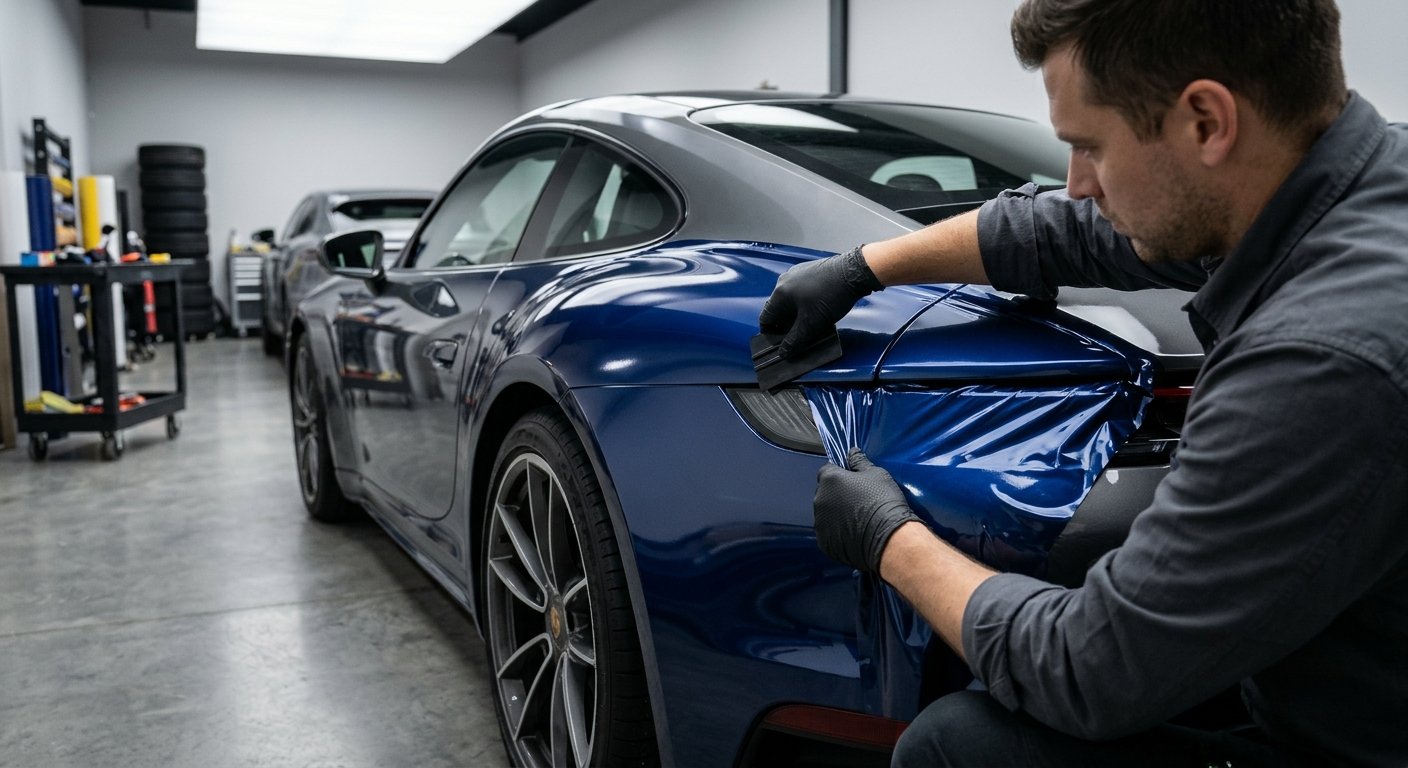
3M ControlTac is a pressure-activated adhesive technology built into 3M’s professional vinyl wrap films that allows installers to reposition the material repeatedly during application without it bonding prematurely. On complex curves, body contours, and recessed panels — the areas where most wrap failures begin — ControlTac gives trained professionals the control needed to achieve a smooth, bubble-free result that lasts. It is a material designed for professional use, not consumer-grade installation.
- ControlTac adhesive only fully activates under applied pressure, giving installers critical repositioning time on complex body panels.
- Microscopic glass beads in the adhesive layer prevent premature bonding, reducing trapped air and stretch distortion.
- Material quality directly determines how well a wrap conforms to curves — and how long it stays there in South Florida’s UV-intensive environment.
- Professional 3M certified installation is required to fully realize ControlTac’s performance advantages.
- Budget vinyl alternatives lack this adhesive architecture, making them far more prone to lifting, bubbling, and edge failure on curved surfaces.
What Makes ControlTac Different From Standard Adhesives
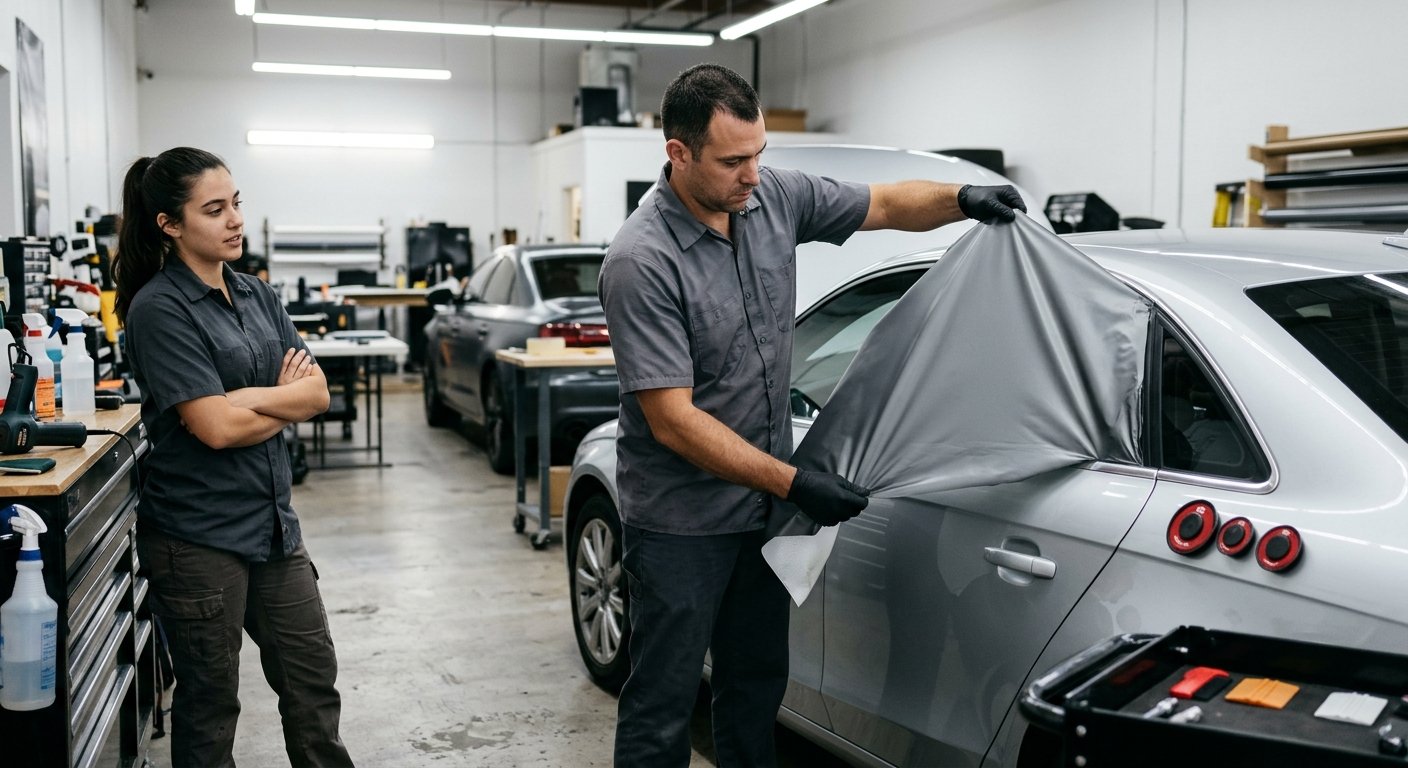
Most vinyl films used in sign-making and basic surface graphics use a standard pressure-sensitive adhesive — meaning the film begins bonding the moment it contacts a surface. That behavior is manageable on flat substrates, but it creates serious problems on vehicle bodywork, where large panels curve in multiple directions simultaneously.
3M’s ControlTac technology changes this dynamic. According to 3M’s product documentation, ControlTac films incorporate a structured adhesive layer with microscopic glass bead technology. These beads create a micro-gap between the adhesive and the substrate, keeping the film from fully committing until deliberate squeegee pressure is applied. The practical result: an installer can float the film into position, adjust alignment, smooth out creases, and work from a central point outward — all before the adhesive fully engages.
On a vehicle with compound curves, this repositionability isn’t a convenience feature. It’s the difference between a wrap that conforms cleanly to every contour and one that traps air, develops stress wrinkles, or pulls away from edges within months.
The glass bead architecture in ControlTac films serves a secondary function: it channels air out of the application zone as the squeegee passes, dramatically reducing the micro-bubbles that can appear in standard films even when installed carefully. This matters most on large, uninterrupted panels like hoods and doors.
Where Curved Surfaces Create Failure Points
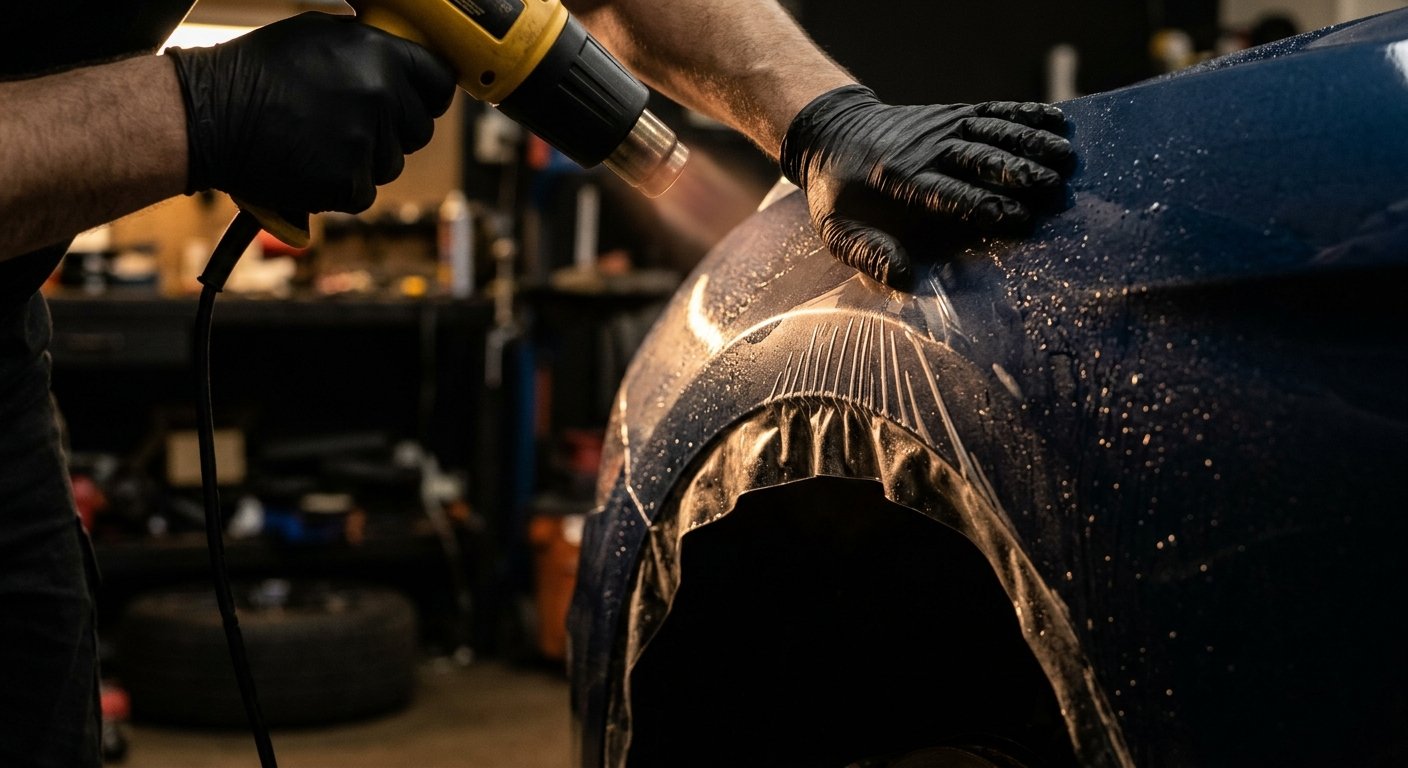
Not all curves are created equal from an installation standpoint. Vehicle bodies present three distinct types of curved surfaces, and each demands something different from the material and the installer.
Simple Curves
A simple curve bends in one direction — think of the gently arched door panel on a standard sedan. These are manageable even with moderate-quality films, provided the installer has proper technique. The risk here is tension buildup: if the film is stretched to conform rather than eased into place, the adhesive is under constant stress and will eventually lose its grip, particularly in high-UV environments like South Florida.
Compound Curves
Compound curves bend in two directions at once — a front fender that sweeps both outward and downward, or a bumper cover that wraps around a corner while also curving vertically. These are where budget films fail most visibly. Without ControlTac’s repositionability, an installer working against a standard adhesive often has to stretch the film past its memory point to achieve conformity, which creates internal stresses the wrap carries for its entire lifespan.
Recessed Panels and Deep Channels
Door handles, body creases, grille openings, and trim recesses are the most demanding surfaces on any vehicle. The film must be pushed into a concave geometry — the opposite of what vinyl wants to do naturally. This requires precise heat application, controlled tension, and a material with enough elasticity to conform without overstretching. 3M’s series 1080 and 2080 films, both using ControlTac adhesive, are engineered with the elongation properties specifically suited to this kind of work. The 3M Graphics resource library provides technical specification sheets for these films that outline their tested elongation and conformability ratings.
| Surface Type | Standard Vinyl Behavior | 3M ControlTac Behavior |
|---|---|---|
| Simple curves | Manages with technique | Clean conformity, repositionable |
| Compound curves | High stretch risk, stress wrinkles | Floats into position before commit |
| Recessed panels | Lifting and edge failure likely | Elasticity + adhesive control = clean channel entry |
| Body creases | Bridging common | Post-heat forming with reliable bond |
The Installation Process on Complex Geometry
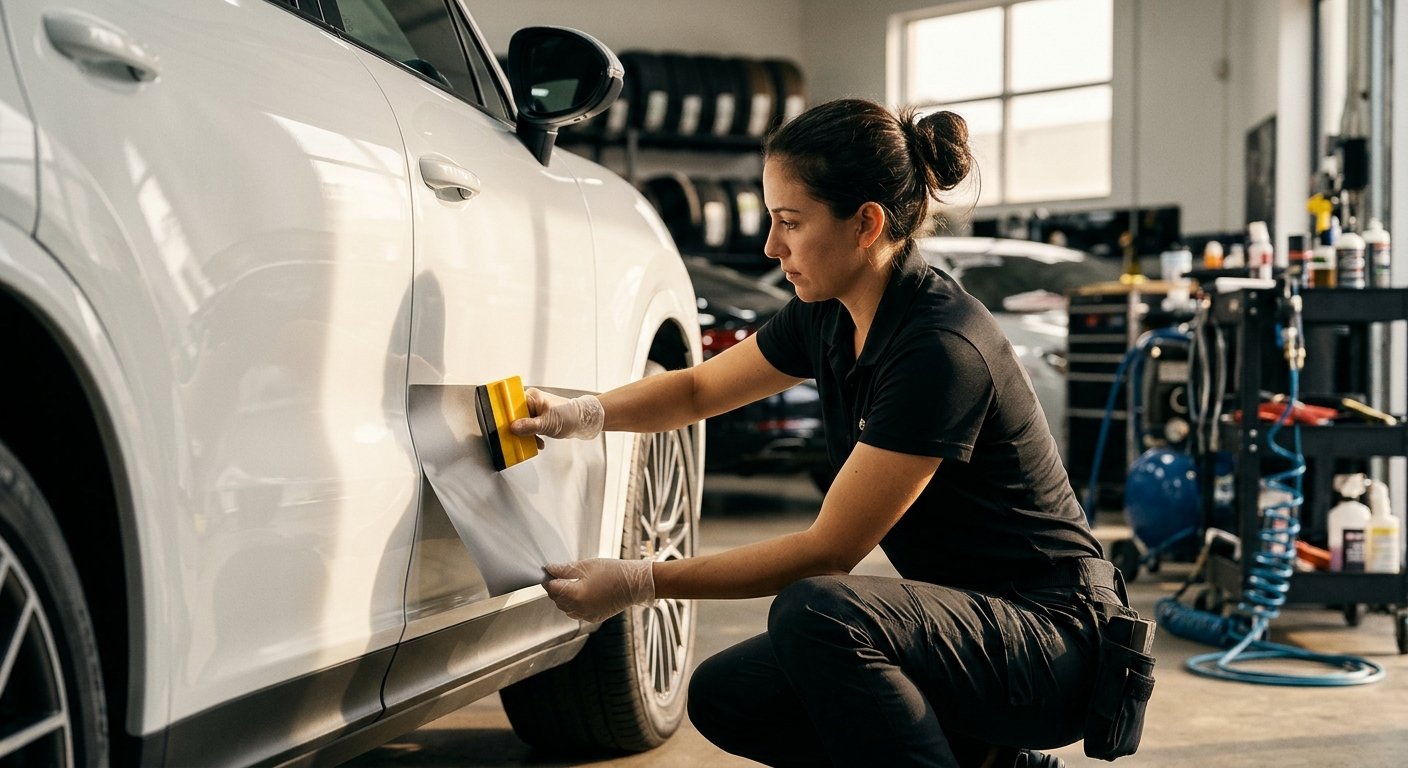
Understanding what ControlTac does is only part of the picture. The material’s advantages are only fully realized when it’s installed by someone trained to work with it. Here is how a professional approaches a complex curved panel.
Surface preparation
The panel is decontaminated, clay-barred if needed, and wiped with isopropyl alcohol. Any surface contamination — wax, silicone, road film — will compromise adhesion regardless of how good the film is. This step is non-negotiable.
Film positioning
The cut panel is floated over the surface with the liner partially removed. ControlTac’s glass beads allow the installer to slide and adjust the film without it grabbing — a critical window for aligning graphics, matching seams, or centering a design element.
Central commitment and outward squeegee work
Starting from the highest point of the curve, the installer applies firm squeegee pressure to initiate bonding, then works outward in overlapping passes. This progressive approach prevents air entrapment and distributes material tension evenly.
Heat forming on transitions
At body creases, edges, and recessed areas, a heat gun is used to soften the film’s memory and allow it to conform without overstretching. Experienced installers know the precise temperature window that makes vinyl workable without degrading its adhesive layer.
Edge sealing and inspection
All edges are sealed with post-heat and additional squeegee pressure. The installer then inspects under directional lighting for any micro-bubbles, lifted edges, or stress patterns that indicate the film is under tension.
Skipping or rushing any of these stages is exactly the kind of installer shortcut that leads to premature wrap failure. If you want to understand what separates careful, professional work from a rushed job, the warning signs are more visible than most people realize — a topic covered in detail in this guide to what it looks like when a wrap installer cuts corners.
Why This Matters Specifically in South Florida
South Florida’s environment places demands on vehicle wraps that installers in cooler, lower-UV regions simply don’t encounter. UV index readings in Fort Lauderdale and Miami regularly reach extreme levels, and salt air along the coast accelerates adhesive degradation on any film with weak edge sealing or surface preparation gaps.
When a ControlTac film is installed correctly, the adhesive architecture is better equipped to maintain bond integrity under thermal cycling — the daily expansion and contraction that South Florida’s temperatures impose on vehicle bodywork. A film that was under internal stress from poor installation, or that used an inferior adhesive system, will show edge lifting and delamination far sooner in this climate than it would in a more temperate region.
Material quality and installation technique are inseparable — one without the other still fails.
This is why understanding how long a wrap realistically lasts under Florida’s specific conditions matters before you invest. The article on vehicle wrap lifespan in Florida’s climate addresses those expectations in practical terms.
After installation, avoid automated car washes with abrasive brushes for the first week — this allows the ControlTac adhesive to reach full cure strength, particularly on edges and recessed areas where the bond is under the most geometric stress.
ControlTac and Premium Vehicle Applications
For luxury, exotic, and high-value vehicles — the kind of work that demands both aesthetic perfection and long-term durability — ControlTac-based films represent the professional standard. The same properties that make them ideal for curves also make them superior for color-change wraps, where large uninterrupted panels must show absolutely no texture variance or adhesive ghosting.
Commercial fleet applications benefit equally. When a wrap carries a company’s brand across multiple vehicles, consistency matters. ControlTac films allow installers to achieve repeatable results panel to panel and vehicle to vehicle — something that’s not possible when working against a standard adhesive that grabs unpredictably. If your business depends on mobile branding that reflects your professionalism, the material behind the graphics is worth understanding. Explore what a professionally executed commercial fleet wrap program in South Florida involves at the technical level.
The 3M certification held by Florida Car Wrap matters precisely here — it indicates that Steve Hargittai and his team have been trained and evaluated by 3M on the proper application of these films. That credential isn’t a marketing label; it represents documented competence with the specific materials and techniques that ControlTac’s performance depends on. Steve’s competition record — including multiple first-place finishes at GOA Wrap Cup Americas and the 2017 Wrapscon Wrap Olympics — reflects how that technical foundation translates into execution at the highest level.
Frequently Asked Questions
What is 3M ControlTac and why does it matter for vehicle wraps?
3M ControlTac is a pressure-activated adhesive technology that uses microscopic glass beads to prevent premature bonding during installation. It allows professional installers to reposition vinyl film on curved and complex body panels before fully committing the adhesive with squeegee pressure. This results in cleaner conformity, fewer bubbles, and better long-term adhesion on challenging vehicle geometry.
Can ControlTac films be used on any vehicle?
ControlTac-based films can be used on virtually any vehicle, from standard sedans and commercial vans to exotic sports cars and marine vessels. The technology is especially valuable on vehicles with aggressive body lines, deep door handles, compound-curved fenders, or recessed trim areas where standard adhesives struggle to perform.
Does material quality really affect how long a wrap lasts?
Yes, significantly. The adhesive system, film thickness, and UV-resistant topcoat all affect longevity — especially in high-UV, salt-air environments like South Florida. Premium 3M films are engineered for outdoor durability in ways that budget alternatives are not. That said, even the best film will fail prematurely if the installation technique is poor, which is why material and craftsmanship must be evaluated together.
What’s the difference between 3M 1080 and 2080 series films?
Both series use ControlTac adhesive, but the 2080 series was developed with enhanced conformability for more complex curves and deeper recesses. The 2080 series is generally preferred for vehicles with aggressive bodywork or heavily contoured panels. A professional installer can advise which series is appropriate based on your specific vehicle’s geometry and the application.
Is 3M certified installation required to use ControlTac films?
ControlTac films are sold through professional distribution channels and are intended for trained installers. 3M certification indicates that an installer has demonstrated competency with these materials through 3M’s own evaluation process. Working with a 3M certified installer is the most reliable way to ensure the material performs as engineered — particularly on demanding surfaces.
Ready to See What ControlTac Can Do for Your Vehicle?
Connect with Florida Car Wrap in Davie to discuss your project — we’ll walk you through material options and what to expect from a 3M certified installation in South Florida.
About Florida Car Wrap
Florida Car Wrap delivers premium vehicle wrap services specializing in commercial fleet branding, luxury car customization, and marine-grade wraps throughout South Florida. Led by award-winning wrap professional Steve Hargittai, the company combines 3M-certified materials with competition-proven craftsmanship to serve discerning business owners and automotive enthusiasts who value longevity and quality over price. Their expertise extends beyond vehicles to architectural graphics, wall wraps, and floor wraps, all executed with attention to South Florida's unique climate demands including UV exposure and salt air considerations. Visit floridacarwrap.com →
