
Not all vinyl is created equal—and nowhere is that truth more consequential than on the water. A boat wrap installed with the wrong material won’t just look bad within a season; it can delaminate, trap moisture against the hull, and create a removal nightmare that costs far more than the original wrap ever saved. Understanding the difference between marine-grade and automotive vinyl is the foundation of any informed decision about watercraft vehicle graphics.
This breakdown cuts through the marketing noise and explains exactly what separates these two categories of material, why South Florida’s environment demands specific solutions, and what professional installation actually looks like when it’s done right.
Why Material Classification Matters on a Boat
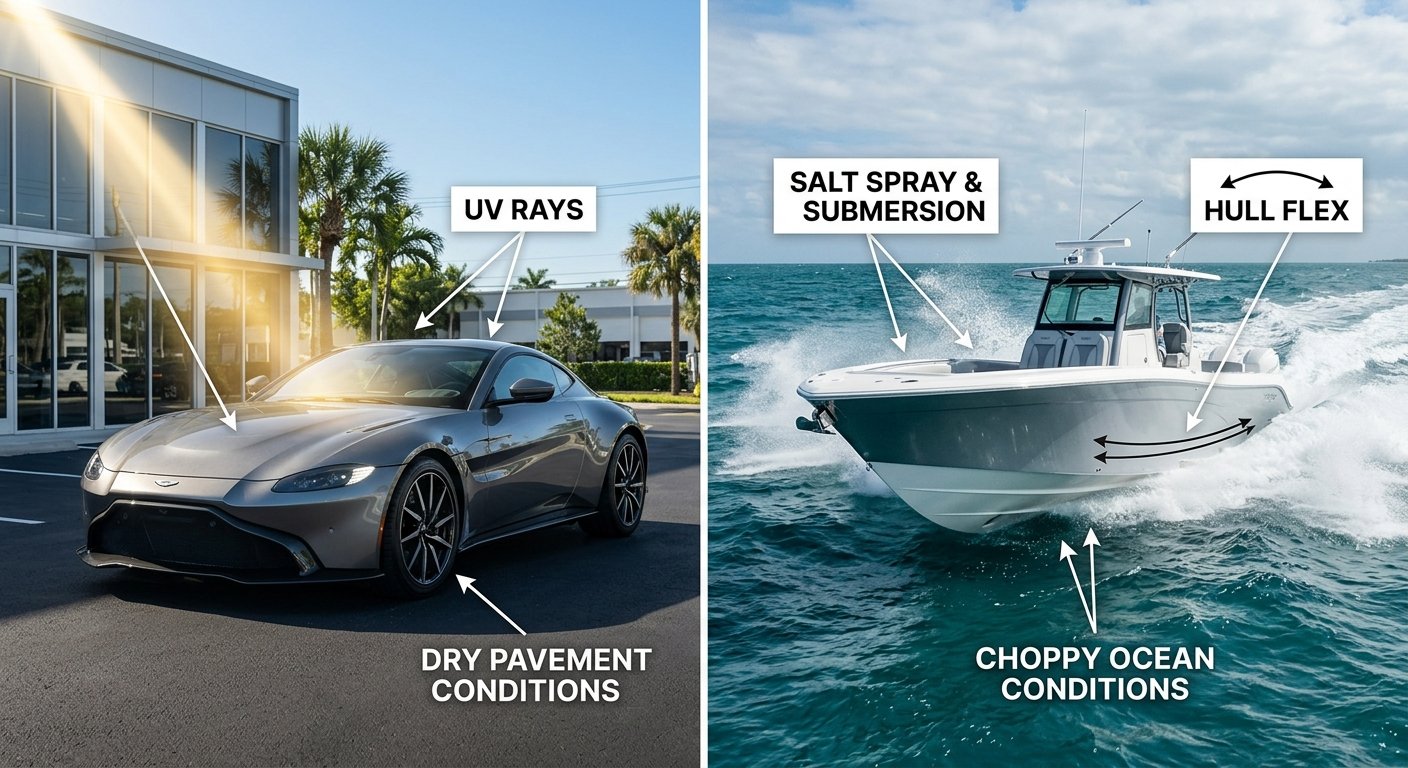
Automotive vinyl wraps are engineered for a controlled set of conditions: road exposure, air contact, occasional rain, and UV from above. A car sits on pavement. A boat sits on—and moves through—water, and that distinction drives an entirely different set of engineering requirements.
When a vessel is underway, the hull experiences hydrodynamic pressure, constant submersion at the waterline, flexing from wave impact, and exposure to salt, fuel, marine organisms, and UV radiation from both above and below (water reflects UV back onto the hull). No automotive wrap film is engineered to withstand that combination of stressors reliably over time.
Marine-grade vinyl films are formulated specifically to address these challenges. The differences are measurable, not just theoretical.
The Key Technical Differences
Substrate Thickness and Flexibility
Marine vinyl films are typically cast films engineered for conformability over complex hull curves and compound surfaces. Cast vinyl is made by spreading liquid PVC onto a casting sheet, which results in a dimensionally stable film that doesn’t have the “memory” or tension of calendered films. This matters on a boat because hulls flex—fiberglass, aluminum, and composite hulls all move under load. A film without adequate flexibility will crack or lift at stress points over time.
Standard automotive calendered films, while suitable for flat or mildly curved vehicle panels, were not designed for the aggressive compound curves found on bow sections and hull transitions. Applying them to those surfaces isn’t just a fitment challenge; it creates ongoing adhesion stress.
Adhesive Formulation
The adhesive layer in marine-grade films is formulated for water resistance and extended submersion at and below the waterline. Automotive adhesives are moisture-resistant but not waterproof in the same sense. Repeated submersion, brackish water exposure, and the osmotic pressures present in a marine environment will degrade a standard automotive adhesive faster than most owners expect.
Marine adhesives are also designed to release cleanly from gelcoat and painted hull surfaces without lifting the substrate when removed—a critical factor, since gelcoat is expensive to repair and difficult to match. The Boat Owners Association of the United States (BoatUS) regularly highlights hull surface protection as a priority concern for owners, and proper wrap adhesive selection is a direct extension of that principle.
UV and Chemical Resistance
South Florida averages over 2,800 hours of sunlight annually, and UV intensity in this region is among the highest in the continental United States. Marine vinyl films carry UV inhibitor packages rated for prolonged sun exposure—both direct and reflected from water. The topcoat laminates on quality marine films are also engineered to resist fuel splash, bilge water, cleaning agents, and marine growth treatments that would degrade standard automotive topcoats.
According to 3M’s marine division, their marine-rated films are specifically tested for these conditions—a meaningful distinction when you’re choosing materials for a significant investment like a vessel.
Where Auto Vinyl Actually Belongs on a Boat
It’s worth being precise here: automotive-grade vinyl is not wrong for every application on a watercraft. Above-deck graphics, registration numbers, deck lettering, console graphics, and other elements that live above the waterline and don’t experience constant submersion or hydrodynamic stress can often be executed successfully in premium automotive cast films—provided the film has appropriate UV resistance and the installer understands marine substrate preparation.
The critical separation point is the waterline. Below it, or at it, marine-grade material is not optional—it’s the professional standard. Above it, the choice depends on the specific surface, exposure, and the quality tier of the automotive film being considered.
At Florida Car Wrap, our approach to boat wraps is always material-first: we evaluate the specific vessel, the surfaces to be wrapped, and the intended use before specifying materials. A center console fishing boat used in the backcountry has different needs than a luxury sport yacht moored in a marina. One-size-fits-all material choices don’t serve either owner well.
The Salt Air Factor in South Florida
Marine automotive wraps in South Florida face an additional variable that inland markets don’t contend with at the same intensity: salt air. Salt is hygroscopic—it draws and holds moisture—and it’s mildly corrosive over time. Even boats that aren’t frequently in the water, if stored near the ocean or Intracoastal, are exposed to elevated salt air concentrations that accelerate adhesive degradation in films not formulated for that environment.
This is a consideration we factor into every consultation. The South Florida wrap environment is genuinely different from wrap environments in the Midwest or even the Pacific Coast, and our material recommendations reflect that. It’s one of the reasons that working with a boat wrap company in Florida that specializes in the regional climate isn’t just a preference—it’s a practical advantage.
Professional Installation: What It Actually Involves
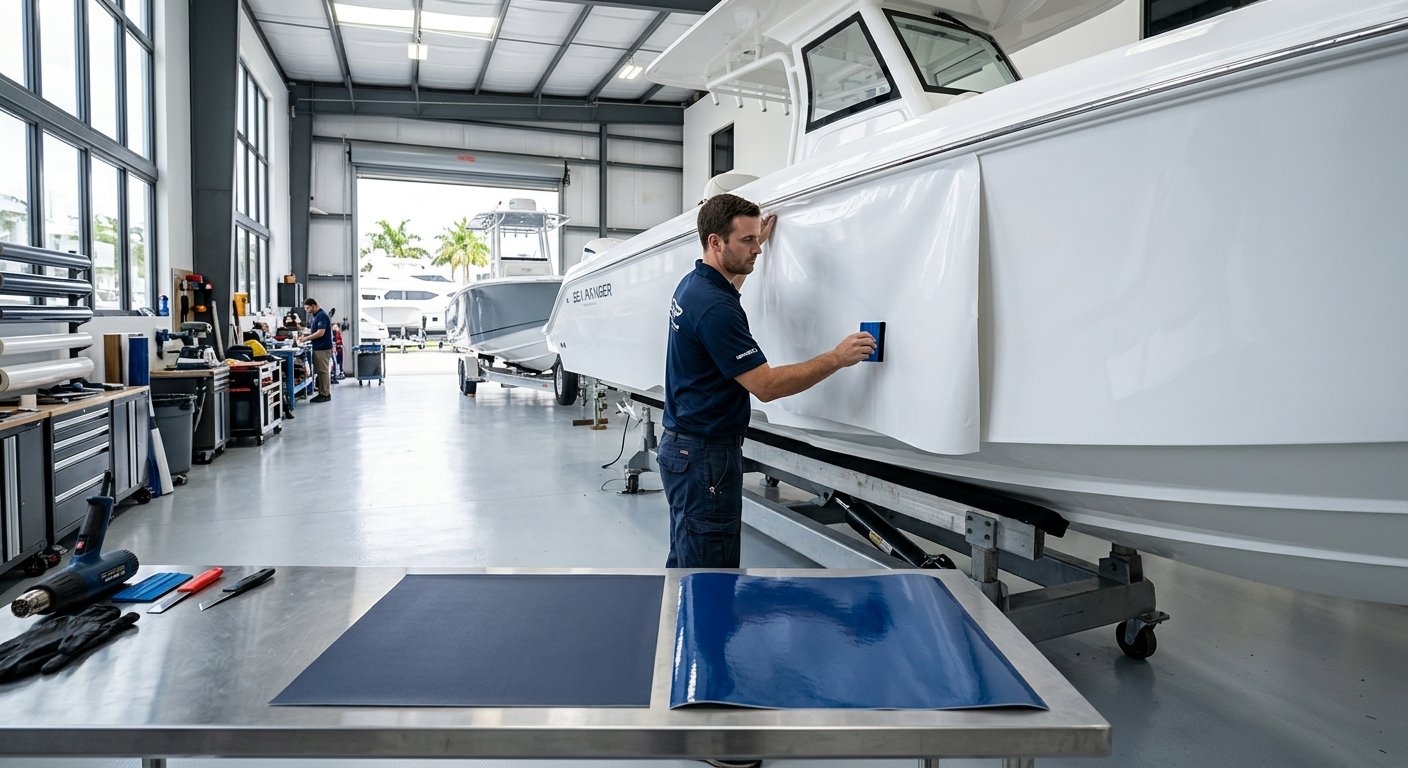
Even the correct material fails without proper installation. Marine wrap installation differs from automotive installation in several important ways.
- Surface preparation: Gelcoat and painted hull surfaces require different cleaning protocols than automotive paint. Contamination at the adhesive interface is the primary cause of premature lifting on boat wraps.
- Seam placement: On a hull, seam placement must account for water flow direction underway. Seams placed against water flow direction will catch and lift; professional installers plan seam locations accordingly.
- Edge finishing: Waterline edges require careful finishing with marine-compatible sealants to prevent water infiltration at the film edge—a detail that automotive wraps typically don’t require.
- Temperature and humidity management: South Florida’s ambient humidity can affect adhesive cure rates during installation. Controlled-environment installation facilities eliminate this variable entirely.
As a 3M Certified installation facility, every wrap we produce—whether for a commercial fleet vehicle or a 40-foot sportfisher—is held to the material handling and installation standards that certification requires. Those standards exist because the consequences of shortcutting them are real and expensive.
Longevity Expectations: Setting Realistic Standards
A professionally installed marine-grade boat wrap on a properly maintained vessel in South Florida can realistically deliver five to seven years of service life with appropriate care. That figure drops considerably with automotive-grade film below the waterline, improper surface preparation, or exposure to aggressive cleaning chemicals not compatible with vinyl films.
Maintenance matters. Marine wraps benefit from regular freshwater rinse-downs after saltwater exposure, mild soap washing rather than pressure washing at close range, and periodic application of wrap-compatible UV protectants. These aren’t extraordinary requirements—they’re the same basic care a quality vessel deserves anyway. The National Marine Manufacturers Association recommends regular hull maintenance as standard vessel ownership practice, and wraps fit naturally within that framework.
Frequently Asked Questions
Can I use automotive vinyl on my boat hull?
Automotive vinyl can work for above-waterline graphics on a vessel, but it is not appropriate for hull applications at or below the waterline. Marine-grade vinyl is formulated with adhesives and UV protection packages designed specifically for submersion, salt exposure, and hydrodynamic stress. Using automotive-grade film below the waterline risks premature adhesion failure and potential hull surface damage upon removal.
How long does a marine boat wrap last in South Florida?
A professionally installed marine-grade wrap using quality cast films typically lasts five to seven years in South Florida conditions when properly maintained. UV intensity, salt air exposure, and frequency of use all affect longevity. Proper surface preparation and professional installation are as important as material selection in achieving that lifespan.
What’s the difference between cast and calendered vinyl for boat wraps?
Cast vinyl is manufactured by spreading liquid PVC onto a casting sheet, producing a dimensionally stable, highly conformable film ideal for complex hull curves and long-term outdoor applications. Calendered vinyl is produced by pressing PVC through rollers, resulting in a thicker, less conformable film with more inherent tension. Marine applications generally require cast vinyl for reliable performance, especially on curved hull surfaces.
Does a boat wrap protect the hull’s gelcoat?
Yes—a properly installed marine wrap provides a physical barrier between the hull surface and UV radiation, minor abrasion, and environmental contaminants. It does not provide impact protection or replace antifouling bottom paint where required. When removed correctly using professional techniques, a marine wrap can leave the underlying gelcoat in better condition than unprotected exposure would.
Do I need a specialist boat wrap company in Florida, or can any wrap installer do it?
Marine wrapping requires specific knowledge of hull substrates, waterline edge finishing, seam placement for water flow, and marine-appropriate adhesives—knowledge that many automotive-only wrap installers don’t have. Working with an installer experienced in marine vehicle wrapping in South Florida’s specific climate conditions significantly reduces the risk of material failure and ensures the work is done to professional standards.
Making the Right Investment
Choosing between marine and automotive vinyl isn’t a question of price—it’s a question of fit for purpose. The right material, applied correctly by professionals who understand both the technical requirements and South Florida’s specific environmental demands, is what separates a wrap that enhances and protects your vessel for years from one that becomes a costly removal problem.
If you’re researching watercraft vehicle graphics or considering a wrap for your vessel, the team at Florida Car Wrap brings the same award-winning craftsmanship and 3M-certified standards to marine wraps that we apply to our custom car wraps and commercial fleet branding. Contact us to discuss your vessel and get material recommendations built around your specific boat, usage, and South Florida conditions.
